
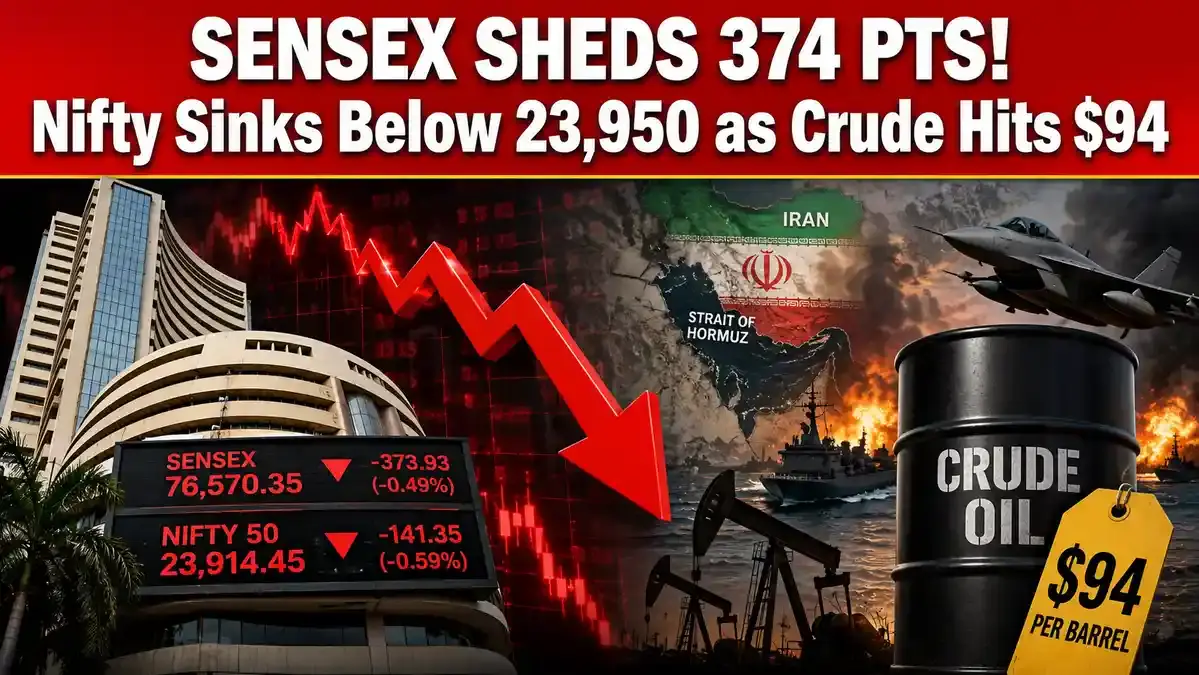

Mumbai: Indian equity benchmark indices extended their losing streak for the third consecutive trading session on Wednesday, September 2, 2026, as escalating military clashes between the United States and Iran around the strategic Strait of Hormuz triggered a sharp spike in international energy prices. The 30-share BSE Sensex dropped 373.93 points (0.49%) to settle at 76,570.35, having plunged nearly 788 points during opening trades to touch an intraday low of 76,155.76. Concurrently, the NSE Nifty 50 surrendered 141.35 points (0.59%) to close below the psychological 23,950 mark at 23,914.45. For detailed coverage on capital markets, monetary policy, and macroeconomic trends, explore our markets desk.
Market Volatility and Key Trading Metrics
The geopolitical shock overshadowed domestic positivity from India's stellar 7.8% Q1 FY27 GDP print released earlier in the week, as risk aversion swept emerging Asian equities:
- Intraday Volatility: The NSE Nifty tumbled to an intraday trough of 23,786.80 before selective short-covering in late afternoon trades curtailed steeper losses.
- India VIX Spikes: The volatility index, India VIX, jumped 3.33%, reflecting rising options hedging and anxiety ahead of upcoming weekly derivative expiries.
- Sectoral Movers: Significant selling pressure was concentrated across Auto (Mahindra & Mahindra fell over 2.1%), private banking majors including HDFC Bank and ICICI Bank, and IT counters. Conversely, state-run Coal India surged over 4%, driven by strong monthly fuel dispatches and fresh filings for its subsidiary IPO.
The Hormuz Catalyst: US-Iran Clashes and Crude Surge
Global energy markets reacted sharply to news of direct military engagements between US naval assets and Iranian forces in Gulf waters. With rhetoric escalating around potential disruptions to terminal operations on Kharg Island—the logistical channel for nearly 90% of Iranian crude exports—fears mounted over physical flow restrictions through the Strait of Hormuz, which carries one-fifth of global daily petroleum consumption.
- Crude Oil Spike: Brent crude futures for October delivery surged beyond $94.80 per barrel (briefly touching intraday highs near $96), while US West Texas Intermediate (WTI) climbed above $91.80.
- Sovereign Yield Pressures: The energy rally pushed the US 10-year Treasury yield toward 4.81%, accelerating foreign institutional investor (FII) capital outflows from emerging equity markets.
Macroeconomic Vulnerability: Why Oil Strains the Indian Economy
With India importing over 85% of its crude oil requirements, a prolonged crude surge above the $90–$95 bracket presents direct macroeconomic headwinds. Sustained energy inflation widens the merchandise trade deficit, piles depreciation pressure on the Indian Rupee (trading near 95.97 per USD), and drives up input costs for lubricants, paints, aviation, and logistics.
Furthermore, analysts warn that higher landed fuel costs could jeopardize the timeline for domestic monetary easing. The Reserve Bank of India's (RBI) Monetary Policy Committee (MPC) is widely anticipated to maintain a prolonged 'hawkish hold' on repo rates to anchor core consumer price inflation rather than considering near-term rate cuts.
Frequently Asked Questions
Ketan
adminPassionate journalist and digital news editor committed to delivering accurate, timely, and fact-checked news.
Related Articles


Latest Articles

Unfathomable Tragedy: A Mother's Despair and a Chi...
Sep 04, 2026
Bittu Tabahi Cleans Ajnar River in MP Single-Hande...
Sep 04, 2026
2026 Tata Curvv Series X Debuts at Rs 10 Lakh: Tri...
Sep 04, 2026
Meta Ads Overhaul: Advantage+ Mandate, Andromeda &...
Sep 04, 2026
Comments (0)
Leave a Comment
No comments yet. Be the first to comment!