
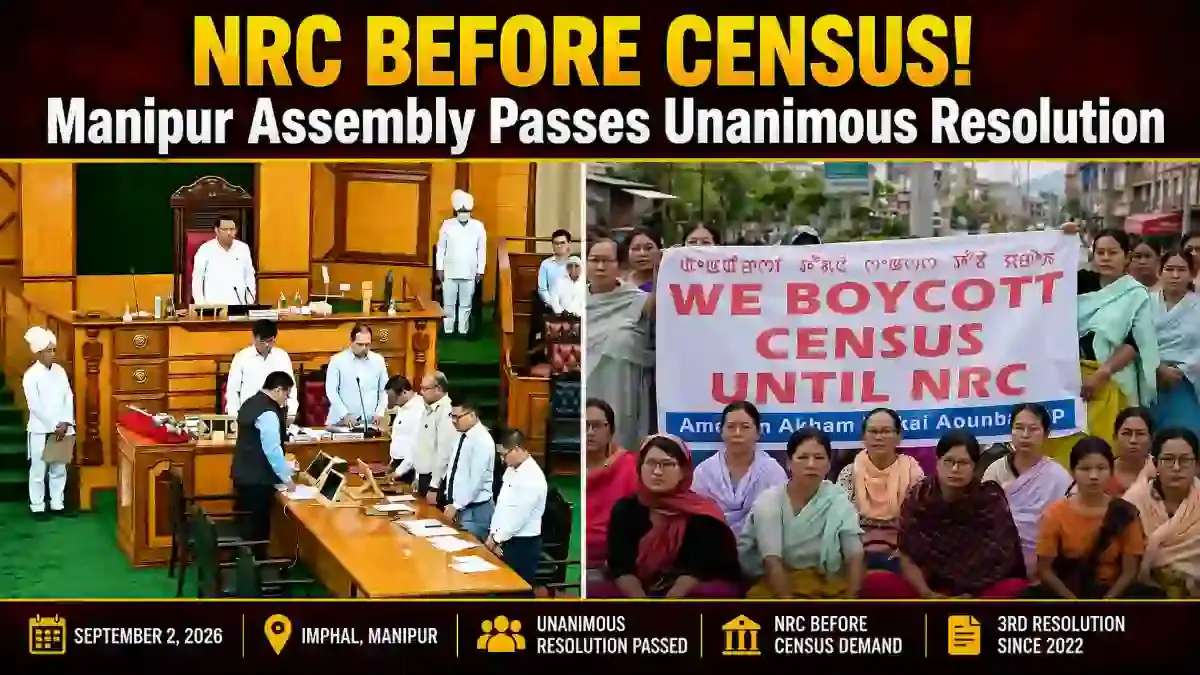

Imphal: Reaffirming its long-standing constitutional stance amid simmering demographic anxieties, the Manipur Legislative Assembly on Wednesday, September 2, 2026, unanimously adopted a resolution urging the Government of India to update the National Register of Citizens (NRC) across Manipur prior to conducting the nationwide decennial Census enumeration. This marks the third legislative resolution passed by the House on this issue, following unanimous adoptions on August 5, 2022, and March 1, 2024. For detailed analysis on regional governance, internal security, and border policies, visit our national affairs desk.
Unanimous Reaffirmation of Previous Legislative Mandates
The resolution was formally moved during the opening sitting of the eighth session of the 12th Manipur Legislative Assembly by Leader of the House and Chief Minister Yumnam Khemchand Singh, and read out by Speaker Thokchom Satyabrata Singh:
"This House once again reaffirms its previous resolutions passed on August 5, 2022, and March 1, 2024, to urge the Government of India to update the National Register of Citizens (NRC) in Manipur before conducting the Census, in the interests of the state in particular and the nation in general."
While the ruling coalition and opposition benches agreed on the imperative of an NRC update, the opposition Congress party, led by former Chief Minister Okram Ibobi Singh, pushed for a broader adjournment debate, highlighting that civil demonstrations and women vendor sit-ins remain active across the Imphal valley seeking a concrete statutory gazette notification and timeline.
Why Manipur Demands an NRC Update Before the Census
The urgency surrounding the legislative push stems from interrelated security, demographic, and political factors:
- Undocumented Influx from Myanmar: Civil society groups, notably Meitei and Naga organisations, contend that conducting a population census without prior citizenship verification would risk enumerating and legitimizing undocumented migrants who crossed the porous international border following post-coup conflict in Myanmar.
- Delimitation Pressures: Groups like the Campaign for Just and Fair Delimitation emphasize that an accurate NRC baseline—with a defined base year such as 1951 or 1961—must precede population enumeration. They argue that unverified headcount figures could artificially alter regional assembly and parliamentary constituency representation during the impending national delimitation exercise.
- Community Perspectives: While valley and hill civil groups staged complete shutdowns demanding binding guarantees, certain Kuki-Zo organizations raised procedural objections, asserting that decisions to postpone census schedules were made without sufficient grassroots consultation, reflecting the persistent trust deficit in the state.
Border Security and Fencing Measures
Addressing calling-attention motions in the Assembly, State Home Minister Govindas Konthoujam reiterated the administration's resolve to protect territorial integrity, clarifying that there is no official report of any bilateral land-swap deal with Myanmar. He informed the House that substantial portions of the international border fencing project along the Indo-Myanmar frontier are nearing completion to prevent clandestine crossings.
The Assembly resolution follows the Union Ministry of Home Affairs' (MHA) decision on August 31 to defer the commencement of the Census house-listing phase in Manipur, finalized after Union Home Minister Amit Shah convened a high-level review in New Delhi with Governor Ajay Kumar Bhalla and Chief Minister Khemchand Singh.
Frequently Asked Questions
Ketan
adminPassionate journalist and digital news editor committed to delivering accurate, timely, and fact-checked news.
Related Articles




Latest Articles

Unfathomable Tragedy: A Mother's Despair and a Chi...
Sep 04, 2026
Bittu Tabahi Cleans Ajnar River in MP Single-Hande...
Sep 04, 2026
2026 Tata Curvv Series X Debuts at Rs 10 Lakh: Tri...
Sep 04, 2026
Meta Ads Overhaul: Advantage+ Mandate, Andromeda &...
Sep 04, 2026
Comments (0)
Leave a Comment
No comments yet. Be the first to comment!