
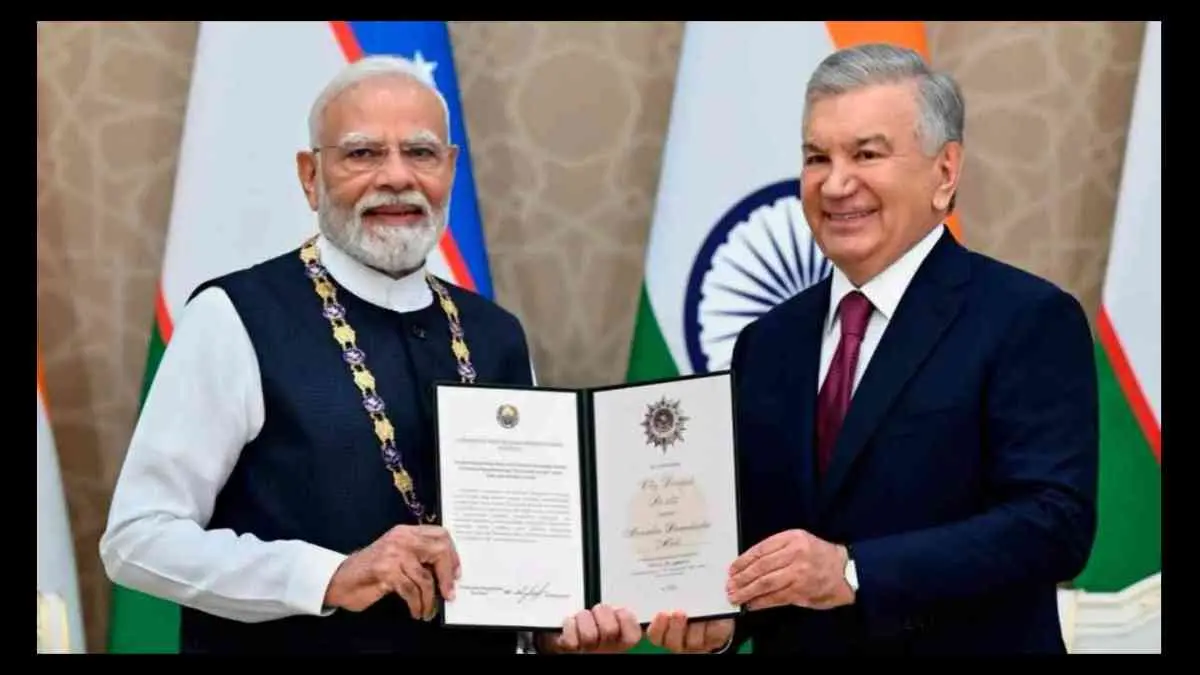

Tashkent: In a landmark diplomatic milestone underscoring New Delhi's expanding outreach across Central Asia, Prime Minister Narendra Modi was conferred the Order of "Oliy Darajali Dustlik" (Supreme Order of Friendship)—the highest civilian and state honor of Uzbekistan—by President Shavkat Mirziyoyev during a high-profile bilateral state visit to Tashkent. Marking the 15th anniversary of formal strategic ties between the two republics, both leaders elevated bilateral relations to a Comprehensive Strategic Partnership. For continuing coverage on international treaties, regional corridors, and summit diplomacy, visit our global affairs desk.
Significance of the 'Oliy Darajali Dustlik' Conferment
President Shavkat Mirziyoyev presented the state decoration to Prime Minister Modi in recognition of his substantial personal contributions to deepening mutual trust, strategic dialogue, and centuries-old civilizational bonds between the two nations.
Accepting the decoration, Prime Minister Modi dedicated the recognition to the 1.4 billion citizens of India and highlighted the shared linguistic and cultural heritage binding the two nations:
"Receiving the Order of 'Oliy Darajali Dustlik' is a profound privilege. The word 'Dustlik'—meaning friendship—resonates deeply with every Indian household, where 'Dost' is spoken millions of times daily. This honor reflects the enduring trust and timeless kinship between our peoples."
President Mirziyoyev lauded India's global leadership across information technology, artificial intelligence, space missions, and digital public infrastructure, noting New Delhi's growing role across international platforms.
Key Strategic Deliverables & Bilateral Accords
The bilateral summit in Tashkent delivered several transformative frameworks spanning energy security, commerce, and institutional governance:
- Long-Term Uranium Supply Agreement: Both governments agreed to establish a stable, long-term procurement framework for uranium to fuel India's clean and civil nuclear energy roadmap.
- Ministerial Coordination Council: A dedicated Coordination Council led by the Foreign Ministers of both countries was instituted to supervise economic roadmaps, trade facilitation, and critical mineral supply chain integrations.
- Upgraded Joint Commission: Oversight of the bilateral Joint Commission was formally raised from Secretary-level to Ministerial-level to eliminate operational bottlenecks and expedite project execution.
Central Asian Transit via INSTC and Chabahar Gateway
Uzbekistan reaffirmed its role as a vital transit gateway for Indian commercial trade into landlocked Central Asian markets through the International North-South Transport Corridor (INSTC) and the strategic Chabahar Port network. Furthermore, the leaders aligned India's 'Viksit Bharat' roadmap with Uzbekistan's 'Yangi Uzbekistan' (New Uzbekistan) modernization initiative, establishing collaborative links between smart urban clusters—such as Gujarat International Finance Tec-City (GIFT City) and New Tashkent—alongside expanded pharmaceutical manufacturing partnerships.
Frequently Asked Questions
Ketan
adminPassionate journalist and digital news editor committed to delivering accurate, timely, and fact-checked news.
Related Articles

Latest Articles

Unfathomable Tragedy: A Mother's Despair and a Chi...
Sep 04, 2026
Bittu Tabahi Cleans Ajnar River in MP Single-Hande...
Sep 04, 2026
2026 Tata Curvv Series X Debuts at Rs 10 Lakh: Tri...
Sep 04, 2026
Meta Ads Overhaul: Advantage+ Mandate, Andromeda &...
Sep 04, 2026
Comments (0)
Leave a Comment
No comments yet. Be the first to comment!