
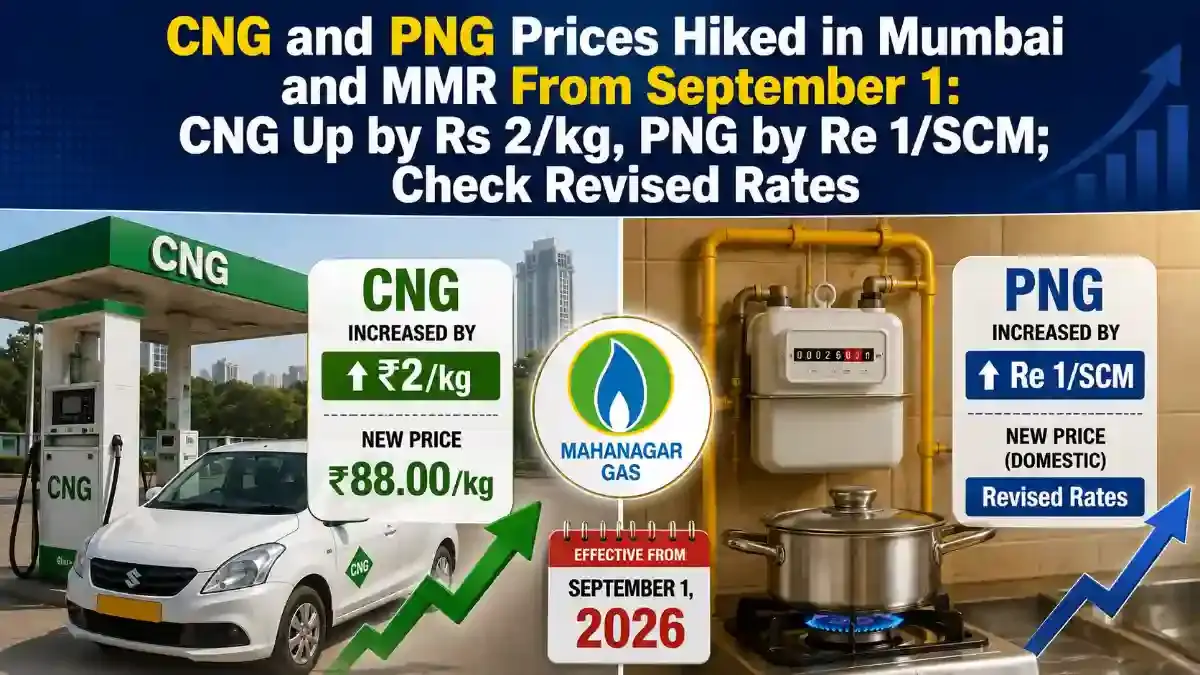

Mumbai: Fuel expenses and domestic kitchen budgets across the Mumbai Metropolitan Region (MMR) increased from the morning of September 1, 2026, as leading city gas distributor Mahanagar Gas Limited (MGL) announced a retail tariff hike across its Compressed Natural Gas (CNG) and Domestic Piped Natural Gas (DPNG) networks. The latest revision sees CNG prices rise by Rs 2 per kg, taking the retail price in Mumbai to Rs 88.00 per kg (up from Rs 86.00 per kg), while piped domestic cooking gas rates have been revised upward by Re 1 per standard cubic metre (SCM). For in-depth reports on urban fuel pricing, consumer inflation, and commodity policies, visit our energy and business desk.
Revised Tariff Structure and Operational Geographies
The revised price matrix came into immediate effect across all retail dispensing pumps and piped meters in MGL's licensed distribution network:
- Compressed Natural Gas (CNG): Retail price adjusted to Rs 88.00 per kg inclusive of local taxes and duties.
- Domestic Piped Gas (DPNG): Increased by Re 1 per SCM across piped residential households.
- Coverage Network: The revised tariffs apply across Mumbai, Thane, Navi Mumbai, Mira-Bhayandar, Kalyan-Dombivli, and Raigad. The updated pricing also extends to MGL's operational geographical areas across Ratnagiri, Latur, and Dharashiv in Maharashtra, alongside Chitradurga and Davangere in Karnataka.
Why Did Gas Prices Increase? Key Cost Drivers
MGL attributed the tariff revision to a confluence of global market friction and rising domestic procurement costs:
- Middle East Volatility & Spot Prices: Sustained geopolitical instability across West Asia has driven up international gas benchmark indices and spot Liquefied Natural Gas (LNG) prices globally.
- Dependence on Costlier Spot RLNG: With domestic Administered Price Mechanism (APM) allocations remaining insufficient to cover the city's expanding fuel demand, city gas operators have been forced to procure significant volumes of expensive imported Regasified LNG (RLNG) at open-market rates.
- Margin Compression: MGL noted that the current Rs 2 per kg hike only partially absorbs the escalation in raw material procurement expenses, ensuring continued operational sustainability and uninterrupted pipeline supplies.
Impact on Transporters and Household Budgets
The tariff adjustment is expected to directly impact daily operating margins for over 13 lakh CNG-powered commercial vehicles, including autorickshaws, kaali-peeli taxis, app-based cabs (Ola/Uber), and light delivery cargo fleets operating across Mumbai, Thane, and Pune transport links. Furthermore, the Re 1 per SCM increase adds marginal cost pressure on more than 30 lakh households connected to piped gas pipelines.
This price hike follows a similar upward revision implemented by Indraprastha Gas Limited (IGL) across Delhi-NCR, reflecting an industry-wide margin correction across India's City Gas Distribution (CGD) framework.
Frequently Asked Questions
Ketan
adminPassionate journalist and digital news editor committed to delivering accurate, timely, and fact-checked news.
Related Articles



Latest Articles

Unfathomable Tragedy: A Mother's Despair and a Chi...
Sep 04, 2026
Bittu Tabahi Cleans Ajnar River in MP Single-Hande...
Sep 04, 2026
2026 Tata Curvv Series X Debuts at Rs 10 Lakh: Tri...
Sep 04, 2026
Meta Ads Overhaul: Advantage+ Mandate, Andromeda &...
Sep 04, 2026
Comments (0)
Leave a Comment
No comments yet. Be the first to comment!