
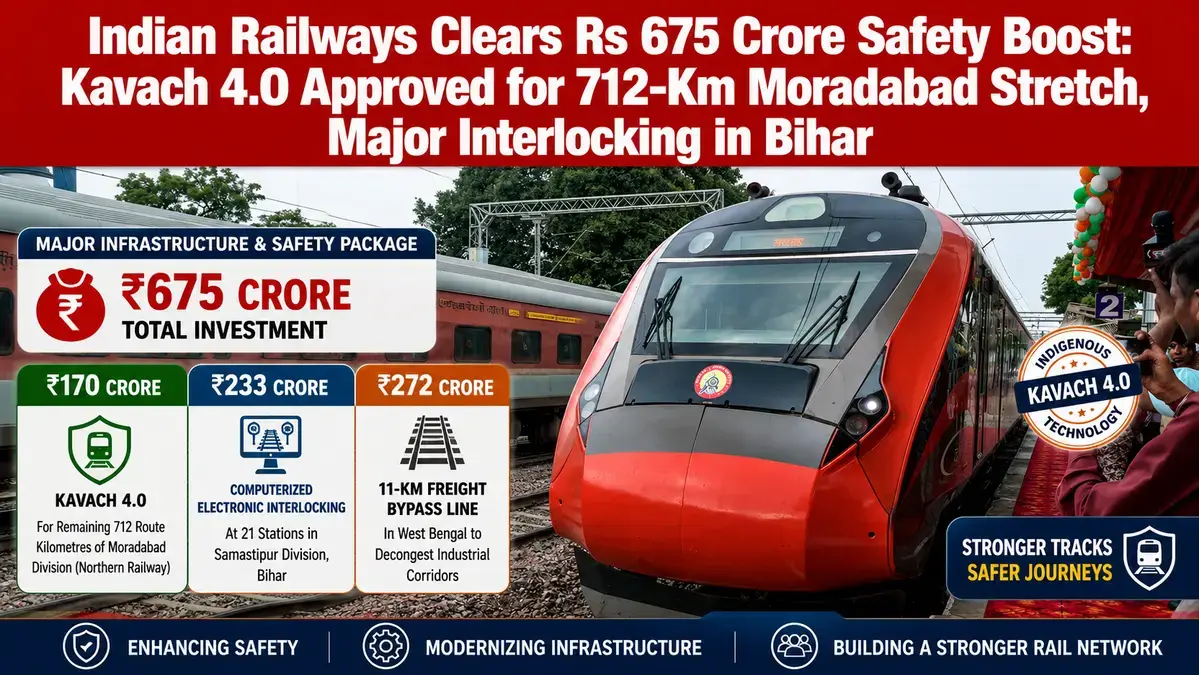

New Delhi: In a major push to modernise rail infrastructure and eliminate train collisions, the Ministry of Railways has sanctioned an integrated safety and capacity package worth Rs 675 crore across Uttar Pradesh, Bihar, and West Bengal. Heading the clearance is a dedicated allocation of Rs 170 crore to implement the indigenously developed Automatic Train Protection (ATP) system, Kavach Version 4.0, across the remaining 712 Route Kilometres (Rkm) of the Moradabad Division under Northern Railway. Alongside the safety rollout, the Railway Board approved modernized computer-based signalling across 21 stations in Bihar and a dedicated freight bypass in West Bengal to untangle critical network bottlenecks. For comprehensive coverage on national logistics, transport modernization, and infrastructure policy, visit our infrastructure desk.
Project Breakdown: Three Key Approvals in the Rs 675 Crore Package
The Railway Board’s capital outlay strategically targets train protection, digital signalling modernization, and freight throughput:
- Kavach 4.0 in Moradabad Division (Rs 170 Crore): Covers the remaining 712 Rkm of Northern Railway's Moradabad sector. The installation creates an electronic fail-safe perimeter designed to prevent Signal Passing at Danger (SPAD), automatically engage pneumatic brakes during driver inaction, enforce speed limits across curved terrain, and prevent head-on and rear-end collisions.
- Electronic Interlocking at 21 Stations in Samastipur (Rs 233 Crore): Sanctioned for East Central Railway in Bihar, replacing aging electromechanical panel interlocking with modern computerized Electronic Interlocking (EI). The upgrade minimizes human error, expedites fault detection, and creates the digital platform needed for future Kavach deployment across the division.
- Adra–Joychandipahar–Sanka Freight Bypass (Rs 272 Crore): Sanctioned under South Eastern Railway in West Bengal, this 11-km bypass line will provide path segregation and direct bi-directional integration with the upcoming third line. Serving as a crucial link in the national Energy, Mineral, and Cement Corridor, it will handle approximately 6.065 freight rakes daily and add 8.88 MTPA in transit capacity by bypassing surface-crossing bottlenecks around Adra junction.
Technical Edge: How Kavach 4.0 Protects Rail Corridors
Certified by the Research Designs and Standards Organisation (RDSO), Kavach 4.0 represents an advanced evolution over earlier trial versions, featuring optimized algorithmic controls suited for high-density railway zones and complex station yards:
- Integrated Telecommunications: The network combines track-embedded RFID tags, locomotive cab units, station computers, and Ultra-High Frequency (UHF) optical radio masts to calculate braking curves dynamically in real time.
- In-Cab Digital Signalling: Cab signalling relays real-time signal aspect displays directly onto the locomotive driver's digital dashboard, ensuring seamless speeds and situational awareness during dense winter fog in northern plains.
Network-Wide Rollout Scale and Safety Record
Kavach 4.0 deployment has surpassed 2,633 route kilometres across priority trunk routes, including 1,423 Rkm on the Delhi–Mumbai corridor and 1,210 Rkm along Delhi–Howrah. Over 21,794 route kilometres across the Golden Quadrilateral and Golden Diagonal networks are progressing through various execution phases, accompanied by locomotive equipment fitments. Supported by an annual safety outlay exceeding Rs 1.14 lakh crore in FY27, consequential train accident indices per million train-kilometres have fallen by more than 90% over the last decade.
Frequently Asked Questions
Ketan
adminPassionate journalist and digital news editor committed to delivering accurate, timely, and fact-checked news.
Related Articles




Latest Articles

Unfathomable Tragedy: A Mother's Despair and a Chi...
Sep 04, 2026
Bittu Tabahi Cleans Ajnar River in MP Single-Hande...
Sep 04, 2026
2026 Tata Curvv Series X Debuts at Rs 10 Lakh: Tri...
Sep 04, 2026
Meta Ads Overhaul: Advantage+ Mandate, Andromeda &...
Sep 04, 2026
Comments (0)
Leave a Comment
No comments yet. Be the first to comment!