
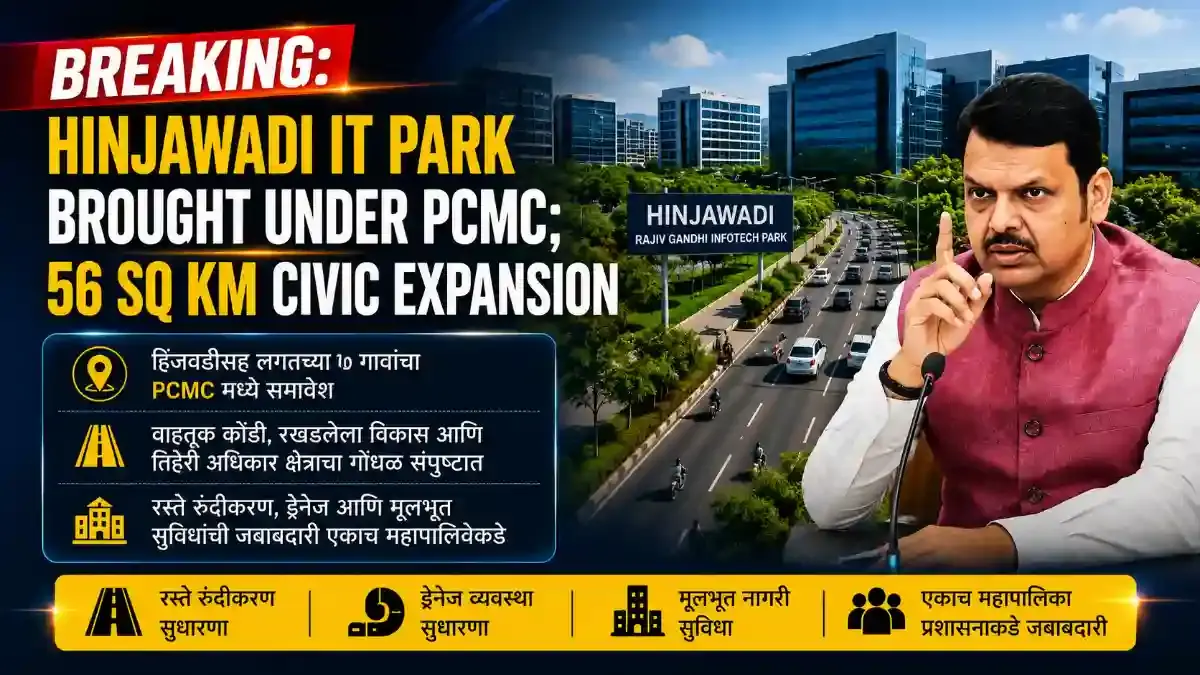

Pune: In a decisive policy move aimed at overhauling urban governance across Pune's premier technology corridor, Maharashtra Chief Minister Devendra Fadnavis has announced that the Rajiv Gandhi Infotech Park in Hinjawadi along with a cluster of seven adjoining villages will soon be formally merged into the jurisdiction of the Pimpri-Chinchwad Municipal Corporation (PCMC). The strategic administrative takeover is structured to eliminate a decade-long multi-agency governance vacuum that has stymied civic infrastructure, daily traffic dispersal, and planned urbanization across the IT belt. For detailed analysis on urban planning, civic administration, and state policy updates, explore our infrastructure desk.
Dismantling the Triple-Agency Paralysis
For over fifteen years, the civic deterioration of Hinjawadi has been compounded by fragmented administrative oversight divided among three distinct government bodies:
- The Institutional Deadlock: Basic administration remained splintered between the Maharashtra Industrial Development Corporation (MIDC) which managed internal industrial plots, the Pune Metropolitan Region Development Authority (PMRDA) handling regional master planning, and local rural Gram Panchayats burdened with civic waste and sanitation.
- Accountability Vacuum: The lack of single-point ownership created a bureaucratic stalemate where no individual department assumed responsibility for widening arterial bottleneck corridors, executing stormwater drainage channels, or tackling illegal encroachments.
- Unified Municipal Governance: Bringing the hub under the PCMC places budgetary allocation, Town Planning enforcement, and round-the-clock road maintenance under one municipal commissioner with proven engineering capacity.
Geographic Scope: Third Historic PCMC Boundary Expansion
This inclusion represents the third major municipal expansion in PCMC's history, following previous boundary revisions in 1997 and 2009. The civic body's territorial jurisdiction will expand by 56.72 square kilometres, jumping from its current 181 sq km to 237.72 sq km, bringing more than 3 lakh residents and a floating tech workforce of nearly 3 lakh professionals under official municipal coverage.
- Hinjawadi (8.33 sq km): Encompassing Phases 1 and 2 of the Infotech Park and the congested Chhatrapati Shivaji Chowk bottleneck.
- Maan (19.05 sq km): Housing Phase 3 IT operations and the major depot infrastructure for Pune Metro Line 3.
- Marunji (6.55 sq km): Critical bypass routes connecting tech corridors to Punawale, Tathawade, and Wakad.
- Jambe and Sangavade (9.81 sq km combined): Strategic western transition corridors connecting outer peripheral townships.
- Gahunje and Nere (10.28 sq km combined): Encompassing the Mumbai-Pune Expressway entry junctions and MCA International Stadium perimeter.
- Dighi and Kalas Pockets (2.61 sq km combined): Municipal alignment segments resolving border layout inconsistencies.
Direct Impact on Roads, Drainage, and Real Estate
Under unified municipal jurisdiction, PCMC can directly deploy statutory Town Planning schemes to fast-track long-stalled link roads, including the dedicated 5-km alternative corridor connecting Phase 1 to Phase 3, elevated flyover networks, and junction widening at Shivaji Chowk. Furthermore, the civic body will replace private water tankers by integrating these peripheral sectors into major municipal water schemes, while restructuring natural nullahs to mitigate recurring monsoon flash floods.
Frequently Asked Questions
Ketan
adminPassionate journalist and digital news editor committed to delivering accurate, timely, and fact-checked news.
Related Articles

Latest Articles

Unfathomable Tragedy: A Mother's Despair and a Chi...
Sep 04, 2026
Bittu Tabahi Cleans Ajnar River in MP Single-Hande...
Sep 04, 2026
2026 Tata Curvv Series X Debuts at Rs 10 Lakh: Tri...
Sep 04, 2026
Meta Ads Overhaul: Advantage+ Mandate, Andromeda &...
Sep 04, 2026
Comments (0)
Leave a Comment
No comments yet. Be the first to comment!