
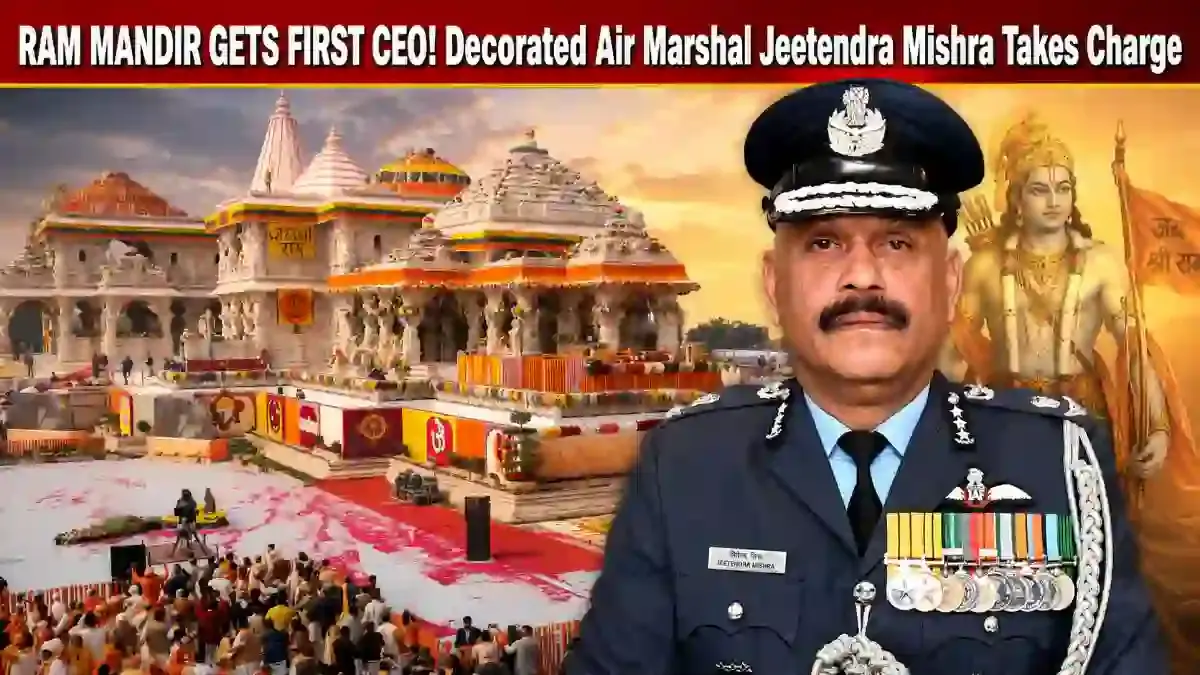

Ayodhya: In a landmark institutional transformation aimed at establishing corporate discipline and restoring public confidence, the Shri Ram Janmabhoomi Teerth Kshetra Trust has appointed retired Air Marshal Jeetendra Mishra as the first full-time Chief Executive Officer (CEO) of the Ram Temple complex in Ayodhya. A highly decorated veteran who commanded the Western Air Command during Operation Sindoor and recipient of the Sarvottam Yudh Seva Medal (SYSM), Mishra will now head the executive and operational machinery of the 70-acre shrine. For comprehensive analysis on institutional administration, public governance, and national developments, visit our national affairs desk.
Rigorous Selection Process and Historical Trust Deed Amendment
Mishra's selection concluded a multi-tiered screening of 5,585 nationwide applications conducted by an independent high-powered committee comprising retired Chief Justice Pramod Kohli, Lt Gen (retd) Vishnukant Chaturvedi, and former Shirdi Sansthan chairman Dr. Suresh Haware. To formalize the post, the Trust passed the first official amendment to its Trust Deed since its founding on February 5, 2020, designating the CEO as the highest executive operational authority responsible for employees, procurement, and statutory compliance.
Leadership Reshuffle Across the Trust
Alongside the CEO's induction, the Trust reconstituted its core leadership structure during its apex meeting at Maniram Das Chhawani:
- General Secretary: Swami Govind Dev Giri was elevated from Treasurer to General Secretary, filling the vacancy following the resignation of Champat Rai.
- Treasurer: Businessman Mahesh Bhagchandka was formally appointed the new Treasurer.
- New Trustees Inducted: The Trust welcomed former Uttar Pradesh Additional Advocate General Madan Mohan Pandey, Shikohabad-based educationist Dr. Nirmala Yadav (the Trust's first woman trustee), and Mahesh Bhagchandka.
Why Did the Trust Appoint a Military Commander as CEO?
The institutional shift from a purely trustee-led management model to structured, military-style executive administration addresses multifaceted ground realities:
- Financial Safeguards and Forensic Integrity: Following recent controversies regarding the handling and alleged pilferage of temple donations—which prompted Special Investigation Team (SIT) probes and multiple arrests—the appointment of a decorated commander establishes automated custody protocols, independent financial auditing, and tamper-proof accounting.
- Separating Religious Custodianship from Administration: Mirroring the governance structures of Tirumala Tirupati Devasthanams (TTD) and the Vaishno Devi Shrine Board, revered seers maintain doctrinal, ritual, and ideological guidance, while an autonomous executive oversees contracts, human resources, facilities, and statutory governance.
- High-Density Crowd Logistics: With daily pilgrim footfalls oscillating between 100,000 and 250,000, Mishra's experience as Deputy Chief of Integrated Defence Staff (Operations) brings expertise in surveillance perimeter networks, crowd throughput control, and emergency incident mitigation.
- Regional and Administrative Neutrality: Hailing originally from Bhopatpura in Deoria, eastern Uttar Pradesh, Mishra brings local cultural familiarity combined with apolitical operational detachment, facilitating frictionless coordination with state authorities and security agencies.
Frequently Asked Questions
Ketan
adminPassionate journalist and digital news editor committed to delivering accurate, timely, and fact-checked news.
Related Articles




Latest Articles

Unfathomable Tragedy: A Mother's Despair and a Chi...
Sep 04, 2026
Bittu Tabahi Cleans Ajnar River in MP Single-Hande...
Sep 04, 2026
2026 Tata Curvv Series X Debuts at Rs 10 Lakh: Tri...
Sep 04, 2026
Meta Ads Overhaul: Advantage+ Mandate, Andromeda &...
Sep 04, 2026
Comments (0)
Leave a Comment
No comments yet. Be the first to comment!