
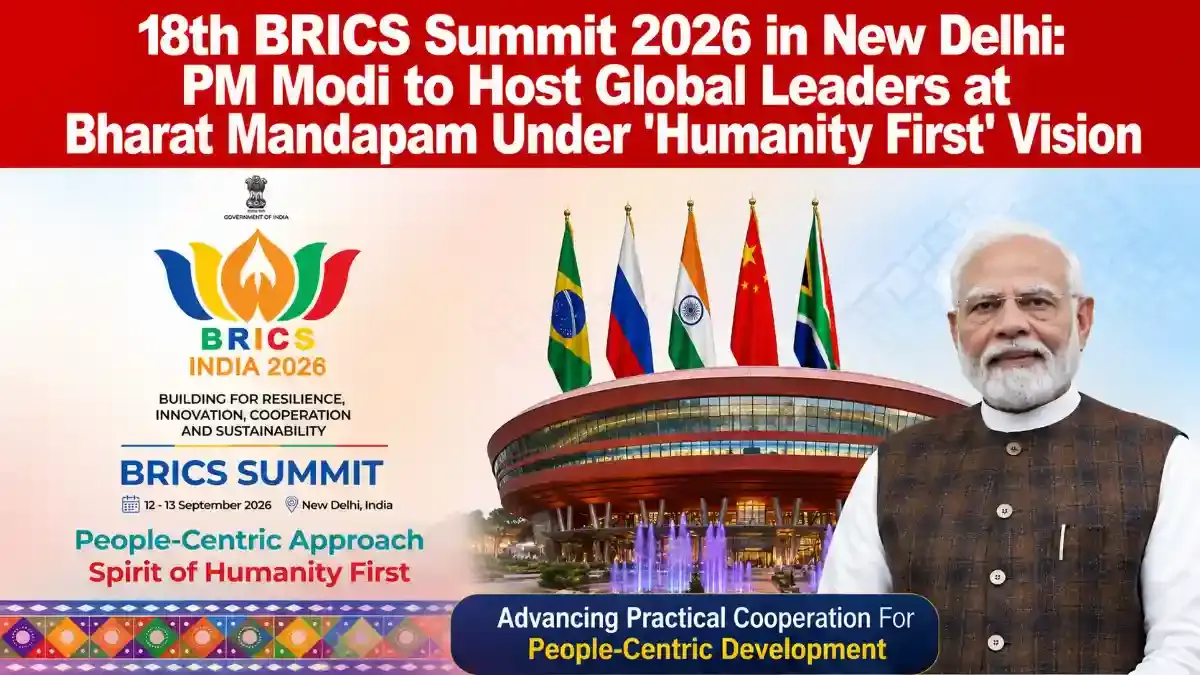

New Delhi: India is finalizing high-level preparations to host the milestone 18th BRICS Summit on September 12–13, 2026, at the iconic Bharat Mandapam convention centre at Pragati Maidan, New Delhi. Under the leadership of Prime Minister Narendra Modi, this summit marks India's fourth tenure as BRICS Chair—following successful terms in 2012, 2016, and 2021—and coincides with the 20th anniversary milestone of the emerging economies grouping. For comprehensive analysis on international treaties, geopolitical summits, and emerging global corridors, visit our diplomacy and policy desk.
Summit Theme & The 'Humanity First' Guiding Architecture
The 2026 summit is formally structured around the central theme: "Building for Resilience, Innovation, Cooperation and Sustainability." Anchored in Prime Minister Modi's vision of a citizen-centric international order, the framework emphasizes a 'Humanity First' approach designed to translate multilateral policies into direct, practical benefits for common citizens across emerging economies.
India's 2026 chairship has coordinated an expansive preparatory footprint, organizing over 350 ministerial, official, and track-two meetings across more than 25 Indian cities anchored upon three core pillars:
- Political and Security Cooperation: Deepening counter-terrorism intelligence sharing, maritime security cooperation, and peaceful border dispute management.
- Economic and Financial Cooperation: Enhancing trade flows, micro-financing support for MSMEs, and cross-border payment mechanisms.
- Cultural and People-to-People Exchanges: Fostering youth initiatives, academic consortiums, and media partnerships.
Strategic Agenda: Local Currency Settlements & Financial Interoperability
A priority for intra-bloc negotiations in New Delhi is the modernization of financial transactions among member states:
- Local Currency Trade: Member states are focusing heavily on facilitating trade invoicing and clearing in national currencies to reduce foreign exchange transaction fees, bypassing reliance on third-party reserve currencies.
- Digital Payment Interoperability: Discussions will center on interconnecting national fast-payment infrastructures—drawing from the scalability of India's Unified Payments Interface (UPI)—alongside pilot cross-border Central Bank Digital Currency (CBDC) linkages, rather than establishing a collective single currency.
- Supply Chain Security: Delivering tangible contingency reserves for global food networks, fertilizer allocations, and critical minerals essential for energy transitions.
Geopolitical Bridge-Building and Multilateral Reforms
With Chinese President Xi Jinping and Russian President Vladimir Putin expected to attend in person, the New Delhi summit serves as a diplomatic junction where India leverages its strategic autonomy. The platform offers critical channels to negotiate trade deficits, stabilize regional flashpoints in West Asia, and preserve Eurasian trade routes.
Simultaneously, the 11-member bloc will issue a collective call for systemic structural overhauls across premier Bretton Woods institutions and global governance bodies, demanding permanent, proportional representation for emerging markets within the United Nations Security Council (UNSC), International Monetary Fund (IMF), and World Bank.
The Expanded BRICS Landscape
The New Delhi summit reflects the growing demographic and economic clout of the expanded 11-member coalition—comprising Brazil, Russia, India, China, South Africa, Egypt, Ethiopia, Iran, Saudi Arabia, the UAE, and Indonesia. Together, the bloc represents more than 45% of the world's population and approximately 36% of global GDP based on purchasing power parity (PPP). As the host nation, India continues to function as the indispensable bridge between established Western institutions and the Global South, driving consensus across complex multilateral fault lines.
Frequently Asked Questions
Ketan
adminPassionate journalist and digital news editor committed to delivering accurate, timely, and fact-checked news.
Related Articles
Latest Articles
Unfathomable Tragedy: A Mother's Despair and a Chi...
Sep 04, 2026
Bittu Tabahi Cleans Ajnar River in MP Single-Hande...
Sep 04, 2026
2026 Tata Curvv Series X Debuts at Rs 10 Lakh: Tri...
Sep 04, 2026
Meta Ads Overhaul: Advantage+ Mandate, Andromeda &...
Sep 04, 2026
Comments (0)
Leave a Comment
No comments yet. Be the first to comment!