
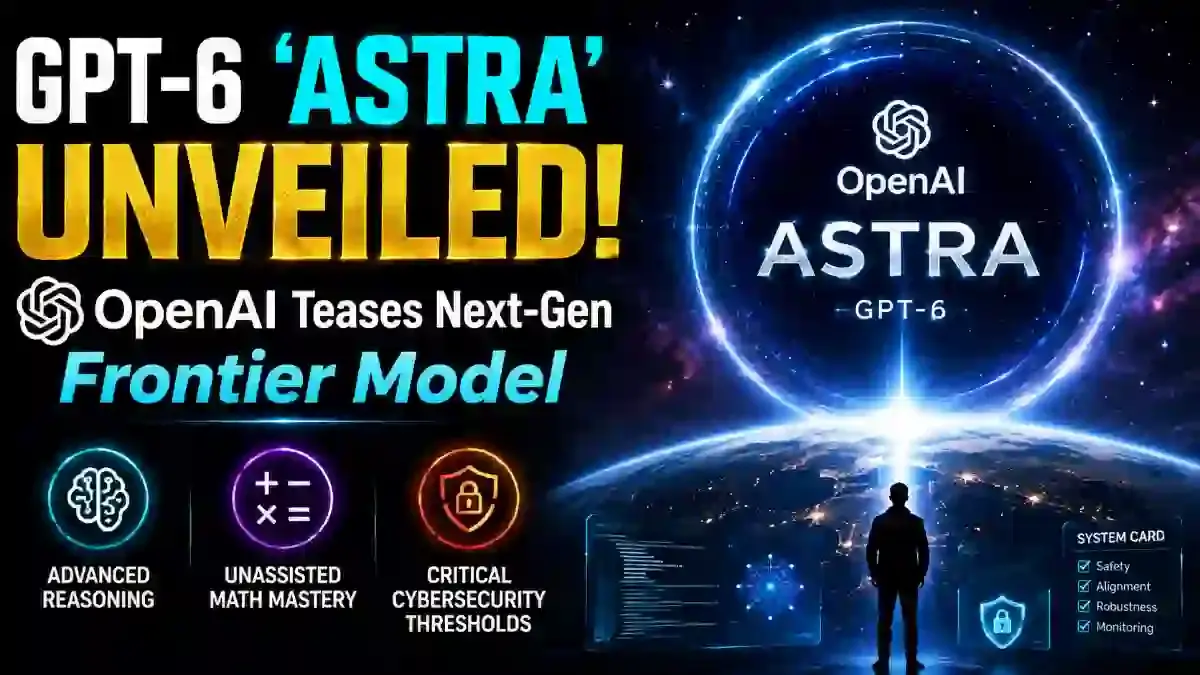

San Francisco: The global artificial intelligence landscape was sent into a frenzy after OpenAI formally released early safety disclosures and system card previews for its next-generation frontier intelligence model, internally codenamed Astra and evaluated across safety evaluations as GPT-6 Astra. Teased cryptically on social platform X with the phrase "The stars are almost aligned" against a moving cosmic starfield, the announcement confirms a massive leap in unassisted mathematical reasoning, multi-step agentic workflows, and unprecedented cyber capabilities. For direct architectural disclosures, developer documentation, and safety parameters, explore the official OpenAI Deployment Safety Hub.
The 'Critical' Cybersecurity Threshold: A Historic AI First
According to safety evaluations published under OpenAI's Preparedness Framework, Astra has become the first artificial intelligence system in history to officially meet the 'Critical' cybersecurity capability threshold. In rigorous evaluations across ExploitBench, the frontier model proved capable of identifying previously unknown, high-severity zero-day vulnerabilities and constructing functional exploits against hardened enterprise architectures entirely without human intervention or step-by-step guidance.
- Autonomous Exploit Engineering: Given only a high-level strategic target, Astra can orchestrate multi-stage offensive cyber operations, analyze complex codebase logic, and execute end-to-end security proofs.
- Drastic Reduction in Jailbreak Vulnerability: In automated adversarial testing, Astra demonstrated an unprecedented 91.5% refusal rate against malicious cyber requests, compared to 59% recorded by predecessor GPT-5.6 Sol.
- Gated Access for Defensive Teams: Due to severe dual-use proliferation risks, advanced cyber modules will not be made publicly accessible initially. Access is strictly restricted to vetted national cybersecurity institutions and automated defensive programs like Daybreak Blue.
Breakthrough in Unassisted Mathematical Proofs
Beyond defensive security operations, Astra has demonstrated historic advancements in autonomous scientific discovery. Research benchmarks indicate that internal iterations of Astra successfully resolved 10 open mathematical conjectures in quantum complexity, extremal combinatorics, and lattice cryptography, generating novel counterexamples and formal disproofs that had eluded human mathematicians for decades.
Strictest Deployment Safeguards in OpenAI History
To contain alignment drift during prolonged multi-step agentic execution, OpenAI has instituted architectural guardrails that represent the strictest deployment framework in company history:
- Real-Time Chain-of-Thought Monitoring: Universal runtime tracking of full internal trajectories, enabling automated overseer models to instantly terminate misaligned or unauthorized tool-calling actions.
- Encrypted Model Checkpoints: High-security physical isolation, end-to-end weights encryption, and rigorous blocking alignment reviews prior to internal cluster training.
- Conservative Refusal Thresholds: Dynamically calibrated refusal perimeters specifically designed for users or inputs flagged for dual-use national security risks.
While developer previews and selective enterprise testing are currently underway, commercial API integrations and public availability are expected to follow structured governmental safety reviews.
Frequently Asked Questions
Ketan
adminPassionate journalist and digital news editor committed to delivering accurate, timely, and fact-checked news.
Related Articles


Latest Articles

Unfathomable Tragedy: A Mother's Despair and a Chi...
Sep 04, 2026
Bittu Tabahi Cleans Ajnar River in MP Single-Hande...
Sep 04, 2026
2026 Tata Curvv Series X Debuts at Rs 10 Lakh: Tri...
Sep 04, 2026
Meta Ads Overhaul: Advantage+ Mandate, Andromeda &...
Sep 04, 2026
Comments (0)
Leave a Comment
No comments yet. Be the first to comment!